

 Image 1 of 1
Private Pilates session
A private Pilates session with all apparatus is a bespoke hour (or customized duration) designed to address your body’s needs, goals, and movement history. It combines both classical Pilates principles with contemporary for individualized instruction, using the full complement of equipment to create a balanced, progressive, and efficient practice. Below is a typical structure and what each apparatus contributes.
Intake and assessment
Brief discussion of goals, injuries, pain, posture, and movement preferences.
Postural and movement assessment: breathing pattern, spinal mobility, pelvic alignment, shoulder mechanics, gait, core stability, and end-range joint mobility.
Establish cues, contraindications, and modifications before beginning.
Breathing and centering
Instruction in lateral thoracic breathing and integration of breath with movement.
Establishing neutral spine or appropriate spinal position for the client.
Activation of the deep stabilizers (transversus abdominis, multifidus, pelvic floor) to create a secure “center.”
Mat work (foundation + warm-up)
Gentle mobility and stability exercises emphasizing alignment, coordination, and breath.
Exercises may include pelvic tilts, supine neutral work, imprinting as needed, bridges, single-leg stretches, thoracic rotations, and shoulder girdle warm-ups.
Purpose: prepare the body, reinforce connections, and gauge baseline control.
Reformer (dynamic control and resistance)
Reformer sessions use spring tension, carriage mobility, and pulleys to train strength, stability, coordination, and full-body integration.
Typical progressions: footwork, leg circles, long box series, short box, knee stretches, elephant, long spine massage, tree, running, and coordinated arm/leg patterns.
Emphasis on controlled eccentric and concentric phases, scapular control, hip-hinge mechanics, and reciprocal limb patterns.
Reformer provides scalable resistance for both mobility deficits and strength building.
Cadillac (trapeze table — mobility, traction, and complex patterns)
Cadillac work addresses spinal decompression, shoulder mobility/stability, rotational control, and complex multi-plane coordination.
Exercises may include roll-downs with straps, push-through series, leg springs for hip control, hanging traction for decompression, and arm springs for scapulothoracic training.
Ideal for clients needing spinal release, controlled traction, or nuanced proprioceptive input.
Combo Chair (functional strength and balance)
Chair work focuses on lower-limb strength, pelvic control, ankle and foot stability, and dynamic balance.
Exercises: single-leg work, pedal presses, side sits, leg presses, and control of eccentric lowering on one or both pedals.
The compact, vertical resistance challenges stabilizers and functional transfer to daily tasks like stepping and squatting.
Ladder Barrel (thoracic mobility and spinal articulation)
Barrel work emphasizes thoracic extension and rotation, hip flexor lengthening, and sagittal plane spinal articulation.
Exercises: rollovers, spine extensions, side bends, and hip stretches over the barrel.
Particularly effective for improving extension mobility, counteracting prolonged flexion postures, and refining pelvic-spine relationships.
Spring-based small apparatus (refinement and targeted conditioning)
Use of single/double springs, magic circle, foam rollers, resistance bands, hand weights, stability balls, and small props for targeted work.
Examples: magic circle inner-thigh and scapular activation exercises; foam roller for fascial release and balance challenges; bands for shoulder external rotation and scapular retraction; light weights for eccentric control in upper-extremity patterns.
These tools refine neuromuscular control and address asymmetries or specific weaknesses.
Integrated flow and skill sequencing
The instructor sequences apparatus work to build from stability to strength to dynamic integration: mat → reformer → cadillac/ladder barrel → chair → small apparatus, or another tailored order.
Transitions emphasize breath, alignment, and fluidity; the session may end with higher-demand integrative moves (e.g., reformer jumps, complex cadillac patterns) if appropriate.
Accessory elements often included
Myofascial release and soft tissue preparation using foam roller or massage ball where indicated.
Joint-specific mobilizations and neurodynamic techniques if within instructor scope and client needs.
Progressive loading strategies and tempo manipulation (slow control vs. faster coordination) to match goals.
Cool-down and reassessment
Gentle stretches, release over barrel/foam roller, and guided breathing to normalize the nervous system.
Re-assessment of key postural or movement markers to note improvements and plan next steps.
Homework: tailored home exercises (mat-based or small apparatus) and movement reminders for daily practice.
Safety, progressions, and personalization
Programming adapts springs, range of motion, tempo, and repetitions to skill level, injury history, and goals.
Emphasis on quality over quantity: precise alignment, breath coordination, and thoughtful movement.
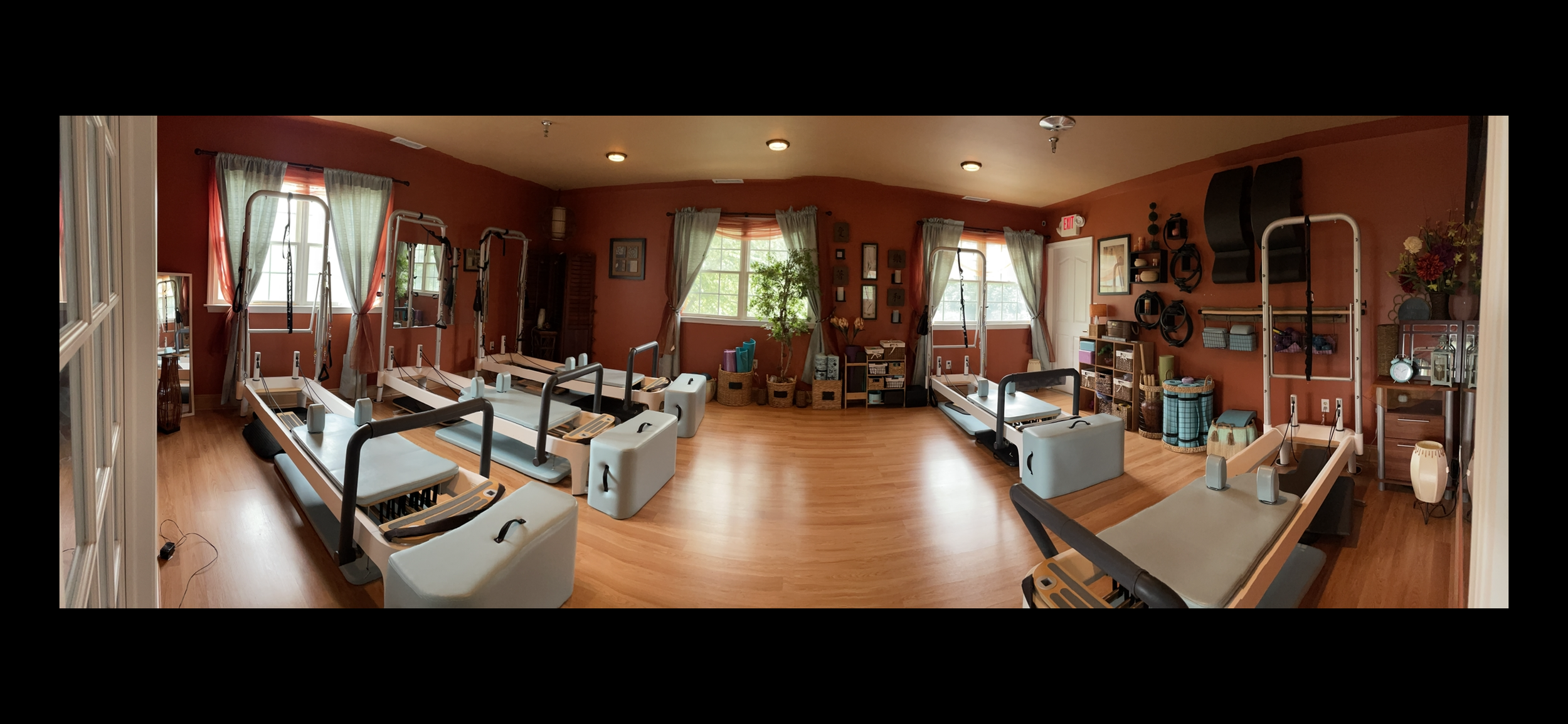
equipment offered: Studio Reformer, Combo chair, EXO chair, Avalon chair, Trapeze Table, Ladder barrel, Spine corrector w/ springs, Core Align, Fuse Ladder and Red cord therapy and more!
.
A private Pilates session with all apparatus is a bespoke hour (or customized duration) designed to address your body’s needs, goals, and movement history. It combines both classical Pilates principles with contemporary for individualized instruction, using the full complement of equipment to create a balanced, progressive, and efficient practice. Below is a typical structure and what each apparatus contributes.
Intake and assessment
Brief discussion of goals, injuries, pain, posture, and movement preferences.
Postural and movement assessment: breathing pattern, spinal mobility, pelvic alignment, shoulder mechanics, gait, core stability, and end-range joint mobility.
Establish cues, contraindications, and modifications before beginning.
Breathing and centering
Instruction in lateral thoracic breathing and integration of breath with movement.
Establishing neutral spine or appropriate spinal position for the client.
Activation of the deep stabilizers (transversus abdominis, multifidus, pelvic floor) to create a secure “center.”
Mat work (foundation + warm-up)
Gentle mobility and stability exercises emphasizing alignment, coordination, and breath.
Exercises may include pelvic tilts, supine neutral work, imprinting as needed, bridges, single-leg stretches, thoracic rotations, and shoulder girdle warm-ups.
Purpose: prepare the body, reinforce connections, and gauge baseline control.
Reformer (dynamic control and resistance)
Reformer sessions use spring tension, carriage mobility, and pulleys to train strength, stability, coordination, and full-body integration.
Typical progressions: footwork, leg circles, long box series, short box, knee stretches, elephant, long spine massage, tree, running, and coordinated arm/leg patterns.
Emphasis on controlled eccentric and concentric phases, scapular control, hip-hinge mechanics, and reciprocal limb patterns.
Reformer provides scalable resistance for both mobility deficits and strength building.
Cadillac (trapeze table — mobility, traction, and complex patterns)
Cadillac work addresses spinal decompression, shoulder mobility/stability, rotational control, and complex multi-plane coordination.
Exercises may include roll-downs with straps, push-through series, leg springs for hip control, hanging traction for decompression, and arm springs for scapulothoracic training.
Ideal for clients needing spinal release, controlled traction, or nuanced proprioceptive input.
Combo Chair (functional strength and balance)
Chair work focuses on lower-limb strength, pelvic control, ankle and foot stability, and dynamic balance.
Exercises: single-leg work, pedal presses, side sits, leg presses, and control of eccentric lowering on one or both pedals.
The compact, vertical resistance challenges stabilizers and functional transfer to daily tasks like stepping and squatting.
Ladder Barrel (thoracic mobility and spinal articulation)
Barrel work emphasizes thoracic extension and rotation, hip flexor lengthening, and sagittal plane spinal articulation.
Exercises: rollovers, spine extensions, side bends, and hip stretches over the barrel.
Particularly effective for improving extension mobility, counteracting prolonged flexion postures, and refining pelvic-spine relationships.
Spring-based small apparatus (refinement and targeted conditioning)
Use of single/double springs, magic circle, foam rollers, resistance bands, hand weights, stability balls, and small props for targeted work.
Examples: magic circle inner-thigh and scapular activation exercises; foam roller for fascial release and balance challenges; bands for shoulder external rotation and scapular retraction; light weights for eccentric control in upper-extremity patterns.
These tools refine neuromuscular control and address asymmetries or specific weaknesses.
Integrated flow and skill sequencing
The instructor sequences apparatus work to build from stability to strength to dynamic integration: mat → reformer → cadillac/ladder barrel → chair → small apparatus, or another tailored order.
Transitions emphasize breath, alignment, and fluidity; the session may end with higher-demand integrative moves (e.g., reformer jumps, complex cadillac patterns) if appropriate.
Accessory elements often included
Myofascial release and soft tissue preparation using foam roller or massage ball where indicated.
Joint-specific mobilizations and neurodynamic techniques if within instructor scope and client needs.
Progressive loading strategies and tempo manipulation (slow control vs. faster coordination) to match goals.
Cool-down and reassessment
Gentle stretches, release over barrel/foam roller, and guided breathing to normalize the nervous system.
Re-assessment of key postural or movement markers to note improvements and plan next steps.
Homework: tailored home exercises (mat-based or small apparatus) and movement reminders for daily practice.
Safety, progressions, and personalization
Programming adapts springs, range of motion, tempo, and repetitions to skill level, injury history, and goals.
Emphasis on quality over quantity: precise alignment, breath coordination, and thoughtful movement.
equipment offered: Studio Reformer, Combo chair, EXO chair, Avalon chair, Trapeze Table, Ladder barrel, Spine corrector w/ springs, Core Align, Fuse Ladder and Red cord therapy and more!
.